
Technical and Advanced SEO

Discover advanced SEO techniques, including technical optimization, site performance, structured data, and strategies to enhance search engine crawling and indexing.

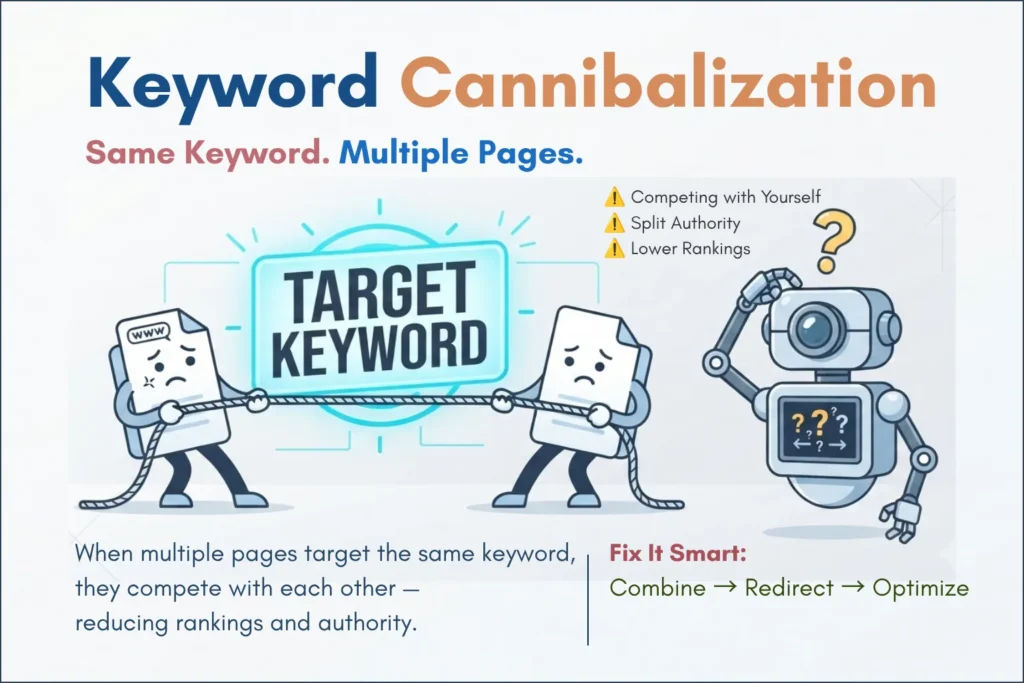
Keyword cannibalization example showing multiple pages competing for the same keyword and lowering SEO rankings

Keyword Cannibalization: Why Your Pages Compete (And How to Fix It)

If you’ve ever published multiple blog posts on similar topics, you may have noticed something strange—your rankings drop instead of improve. One page replaces another. Or worse, both disappear. This is called keyword cannibalization, and it silently kills your SEO performance. It happens when Google gets confused; because you have multiple pages on your site […]

Keyword Cannibalization: Why Your Pages Compete (And How to Fix It) Read More »

Infographic explaining why Google indexes a page but does not rank it, showing indexing and ranking stages with visual comparison

Why Google Indexes Your Page But Doesn’t Rank It (Fixes That Actually Work)

If you are a blogger or a website owner, you have likely experienced the “indexing frustration.” You spend hours researching keywords, writing a comprehensive article, and hitting the publish button. You wait a few days, check Google Search Console (GSC), and see that beautiful “Page is indexed” message. If your page is indexed but getting

Why Google Indexes Your Page But Doesn’t Rank It (Fixes That Actually Work) Read More »

Google Business Profile showing high views but no calls with frustrated business owner looking at low conversions

Why Your Google Business Profile Gets Views but No Calls (5 Proven Fixes)

The “Traffic Looks Good, but the Phone Isn’t Ringing” Problem Your Google Business Profile official page is often the first thing customers see when searching for your business. Many business owners feel stuck in this exact situation: You open your Google Business Profile dashboard and see: But when you check actual results: This creates confusion

Why Your Google Business Profile Gets Views but No Calls (5 Proven Fixes) Read More »

Local business improving Google Maps ranking by targeting neighborhood SEO instead of near me keywords

Service Area vs Physical Location SEO: Why Most Businesses Choose Wrong (And Lose Rankings)

The “Service Area vs. Physical Location” Trap If you run a service-based business—like a plumber, electrician, caterer or freelancer—you’ve probably faced this frustrating situation: You serve a large area (like all of Mumbai), but when someone searches: Your business doesn’t show up. Meanwhile, smaller competitors with physical shops in those areas dominate the results. This

Service Area vs Physical Location SEO: Why Most Businesses Choose Wrong (And Lose Rankings) Read More »

Comparison of fake reviews vs real reviews showing impact on Google Maps ranking and business growth

Why Fake Google Reviews Fail: Build a Bulletproof Strategy That Actually Ranks

What are fake Google reviews?Fake Google reviews are artificially created ratings posted using fake accounts or incentives to manipulate rankings. If you are running a local business and trying to rank in Google’s highly competitive Maps 3-Pack, you’ve probably noticed something frustrating. Your competitors seem to have: Meanwhile, your business: This creates a serious question:

Why Fake Google Reviews Fail: Build a Bulletproof Strategy That Actually Ranks Read More »

Local SEO citations and NAP consistency concept for improving Google Maps rankings

Local SEO Citations: The Ultimate Guide to NAP Consistency

If you are a business owner in a competitive hub like Mumbai, you’ve likely noticed a frustrating trend: some businesses seem to “stick” to the top of Google Maps, while others—even those with better services—stay buried on page two. You have already optimized your Google Business Profile, so what is the missing link? The answer

Local SEO Citations: The Ultimate Guide to NAP Consistency Read More »

Noindex vs Robots.txt vs Canonical tags explained for SEO crawling, indexing, and duplicate content control

Noindex vs Robots.txt vs Canonical: When to Use What? (Beginner Guide)

When working on SEO, many beginners get confused between noindex, robots.txt and canonical tags. They may seem similar, but each one serves a completely different purpose. If you use the wrong one, your pages may not appear in search results, or worse — important pages might lose rankings. In this guide, you’ll clearly understand: Let’s

Noindex vs Robots.txt vs Canonical: When to Use What? (Beginner Guide) Read More »

Canonical URL explained showing duplicate pages pointing to one preferred URL for SEO

Canonical URL Explained: Fix Duplicate Content Issues

When you publish content on your website, the same page can sometimes be accessible through multiple URLs. This can happen because of URL parameters, different URL formats, site functions, or duplicate versions of similar content. Google can group these URLs together and choose a representative URL, known as the canonical URL. A canonical URL helps

Canonical URL Explained: Fix Duplicate Content Issues Read More »

Visual comparison of XML Sitemap as a roadmap and Robots.txt as a gate controlling search engine crawling and indexing for SEO

Sitemaps vs. Robots.txt: Which One Controls Your SEO? (Guide)

When you start a blog, one of the first goals is to get your pages indexed in Google. However, many beginners don’t realize how search engines actually discover and prioritize content behind the scenes. Two important files play a major role in this process: the XML sitemap and the robots.txt file. While they may seem

Sitemaps vs. Robots.txt: Which One Controls Your SEO? (Guide) Read More »

Illustration showing how to optimize WordPress robots.txt file for SEO, crawl budget management and search engine indexing

Optimize WordPress Robots.txt for SEO (Complete Guide)

If you’re running a WordPress website or planning to grow your blog, you’ve probably heard about the robots.txt file. But most beginners either ignore it or use it without fully understanding how powerful it actually is. In simple terms, this small file controls how search engines interact with your website. A single wrong instruction can

Optimize WordPress Robots.txt for SEO (Complete Guide) Read More »

Scroll to Top