
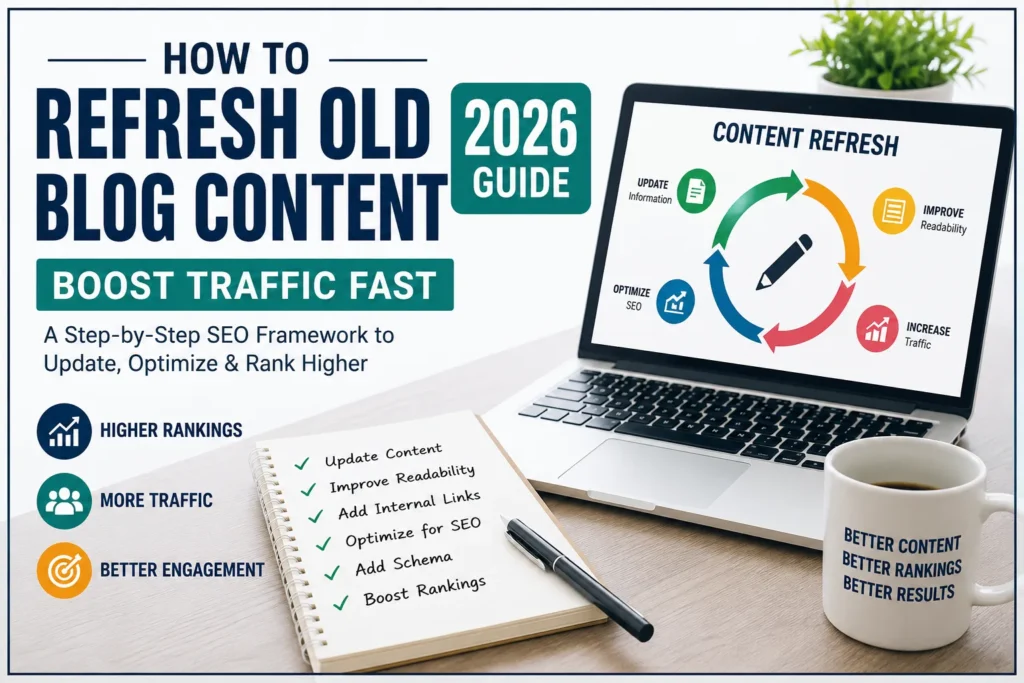
Hello everyone! We hope you benefited from our previous posts. Now, let’s continue our journey with a brand-new topic. If your blog traffic is dropping even though you’re publishing regularly, your old content might be silently killing your rankings.
Even the most successful websites experience “content decay”—where once high-performing pages slowly lose traffic over time.
The good news? You don’t need to write new posts to see results. Refreshing your old content is one of the most effective ways to boost your SEO in 2026. In this guide, we will walk through a step-by-step framework to take your decaying pages and turn them into high-performing assets that satisfy both human readers and AI-powered search engines.
- Why Refreshing Old Content Matters in 2026
- The 6-Step Content Refresh Framework
- The Art of "Content Pruning (Content Cleanup )" and Consolidation
- Optimizing for "People-First" Content Metrics
- Technical Health: The Hidden Factor of Refreshes
- Common Content Refresh Mistakes to Avoid
- Frequently Asked Questions (FAQs)
- Conclusion
Why Refreshing Old Content Matters in 2026
Content decay happens because search intent changes, competitors improve their articles and information becomes outdated. Google’s algorithms favor fresh, relevant and comprehensive content. By updating your older posts, you signal to Google that your site is active, authoritative and helpful, which can lead to better rankings and more traffic.

Benefits of refreshing old content including rankings, traffic and authority growth.
Quick Summary:
- Refreshing content improves rankings faster than new posts
- Focus on search intent + structure + freshness
- Fix technical issues before updating content
If your page is indexed but still not ranking after content decay, it may be affected by deeper issues explained in our guide on why Google indexes pages but doesn’t rank them.
The 6-Step Content Refresh Framework
Follow this simple, actionable process to maximize your visibility.

1. Identify Decaying Pages
Don’t guess which posts need work. Use Google Search Console (GSC) to find data-backed opportunities.
- Compare Periods: Go to the “Performance” report and use the “Compare” feature to look at the last 3 months versus the previous 3 months.
- Look for Losses: Sort your pages by the biggest drop in clicks.
- Analyze Queries: Click on a dropping URL and check the “Queries” tab to see which specific search terms are failing to drive traffic.
2. Analyze Search Intent
Why do people search for your keywords? The answer changes over time. Search your target keywords and look at the top three results.
- Do they use videos?
- Do they offer calculators or checklists?
- Are they more “how-to” focused than your current post?
If your competitors cover a sub-topic you missed, add it. Closing these content gaps quickly helps you outrank your competitors.
3. Rewrite for Readability
Modern readers and AI engines prefer structure over long, dense walls of text.
Poor structure and formatting can also limit your rankings, which is why fixing issues covered in our readability and parsing errors in SEO guide is essential.
- Use Clear Headings: Use H2 and H3 tags to break content into logical sections.
- Format for Extractability: Use bullet points, checklists and comparison tables. Tables and structured content are more easily extracted by search engines and AI-powered results.
| Content Element | Why It Works for 2026 |
|---|---|
| Question-based Headings | Directly matches “People Also Ask” queries. |
| Comparison Tables | Highly extractable for AI search summaries. |
| Summary Boxes | Gives the user the “TL;DR” immediately. |
Before finalizing your content, use our Word and Character Counter Tool – Count Words Instantly to ensure your blog post length is well-optimized for SEO and readability.
4. Update Entities and AI Optimization
AI models, like those powering Google’s AI Overviews, learn by identifying “entities”—the people, places, tools and concepts mentioned in your text.
- Modernize Examples: If you are citing a tool or a strategy, make sure it is current for 2026.
- Add Real Brands: Mentioning industry-recognized tools or authoritative sources helps search engines contextualize your content.
- Visuals: Replace old, pixelated screenshots with fresh, original graphics or embedded videos.
Updating content without fixing crawl or indexing issues can limit your results.
5. Add Fresh Internal Links
Internal linking is the “link equity” bridge that helps Google crawl your site. When you refresh an old post, link to it from your new, high-authority articles. If you aren’t sure how to build these links effectively, study our Technical SEO Performance Guide to learn how to structure your site for maximum crawlability.
6. Deploy Schema Markup
Structured data, specifically FAQ Schema, tells search engines exactly what your content is about.
- By implementing FAQ schema, your pages gain a much higher chance of appearing in AI-generated search results.
- Aim to keep these answers brief, ideally between 40 and 60 words, to maintain clarity and directness for your audience. You can easily create structured data using our Free FAQ Schema Markup Generator – Create FAQ JSON-LD Instantly, which helps you generate ready-to-use schema in seconds.
The Art of “Content Pruning (Content Cleanup )” and Consolidation
At times, the smartest move when updating content is to let go of an article that isn’t working instead of trying to fix it. If you have five short, thin posts on very similar topics, they are likely competing against each other, leading to “keyword cannibalization.”
Instead of updating all five, you should merge them into one comprehensive “Pillar Page.” As explained in our guide on Keyword Cannibalization Guide in SEO, consolidating content helps you build topical authority. After merging, use a 301 redirect to send the traffic from the old, deleted URLs to your new, high-quality master guide. This passes the ranking power of those old pages to the new one, giving you a massive SEO boost overnight.
Optimizing for “People-First” Content Metrics
Google is increasingly focusing on “Helpful Content.” This means they want to see that your post was written by an expert, for a human reader, not just to rank on a search engine.
To improve your “people-first” scores:
- Add Personal Anecdotes: Share a real-world experience, such as a challenge you faced with Google Search Console, as detailed in our guide on Google Search Console Errors.
- Answer the “Next Question”: Think about what the user will want to know after they solve their current problem. By addressing the next step in their journey, you reduce bounce rates and increase engagement.
Technical Health: The Hidden Factor of Refreshes
You cannot refresh your content effectively if your site’s technical foundation is broken. A common mistake is updating the text while ignoring the performance.
| Technical Check | Action Item |
|---|---|
| Image Size | Convert old images to WebP to improve load speed. |
| Crawl Errors | Fix 404 links found in your GSC dashboard. |
| Mobile UX | Test how your new tables look on a smartphone. |
Before you spend hours writing new sections, check your robots.txt file to ensure Google is actually allowed to crawl the pages you are updating, as discussed in our Optimize Robots.txt SEO Guide. If Google can’t crawl the page, your updates won’t be indexed, and your hard work will be wasted.
Common Content Refresh Mistakes to Avoid
Ignoring User Experience (UX): Even with great content, if your page loads slowly, users will bounce. Ensure your images are compressed and your site is mobile-friendly.
Changing URLs: Never change the URL of an old post unless absolutely necessary. If you do, ensure you set up a 301 redirect, or you will lose all the SEO authority that page has earned.
Keyword Stuffing: Write naturally for humans first. Google’s algorithms are sophisticated enough to understand context without needing you to repeat the same phrase 50 times.
Frequently Asked Questions (FAQs)
1. How frequently should you revisit and refine your existing articles?
A good rule of thumb is to audit your content every 6–12 months. If a post is seasonal, update it about a month before the peak season begins.
2. Does updating the “Published Date” help?
Yes! Updating the date informs both Google and your readers that the content is current and reliable.
3. What if I have a duplicate content issue?
Use canonical tags. We have a full tutorial on how to handle this in our Canonical URL Guide.
4. Can refreshing content improve rankings without backlinks?
Yes, refreshing content can improve rankings without backlinks if you significantly improve search intent alignment, content quality and structure to better match user needs.
Conclusion
Refreshing your content isn’t just about tweaking a few sentences; it’s about ensuring your site provides the best, most current answer to your reader’s question. By following this framework—identifying decay, optimizing for intent, structuring for AI, and keeping a human tone—you’ll not only survive but thrive in the 2026 search landscape.
Start by refreshing your top 3 posts today using this framework. Even small updates can lead to significant ranking improvements within weeks.
Suggested Further Reading
- How to Structure a Blog Post for SEO: Beginner-Friendly Guide
- Keyword Cannibalization: Why Your Pages Compete (And How to Fix It)
- Why Google Indexes Your Page But Doesn’t Rank It (Fixes That Actually Work)
- Most Common Google Search Console Errors (404, Discovered and Crawled)
- Readability & Parsing Errors in SEO (Beginner Guide)
- Comprehensive Guide: Fixing Redirect, Canonical and Duplicate Errors in GSC
- The Ideal Guide to Domain, Hosting and WordPress for Beginners
- The Ultimate Guide to Image SEO: Rank Higher and Load Faster
- Ultimate Guide to Keyword Research for Beginners
- SEO Mistakes to Avoid for New Websites (Beginner Guide)
- Use On-Page SEO Techniques to Boost Rankings Fast
✍️ About the Author
Digital Smart Guide is dedicated to simplifying SEO and digital marketing for beginners and professionals.
We share practical, easy-to-understand strategies based on real experience and ongoing learning from Google updates.
Disclaimer
This content is for informational purposes only. Results may vary based on your niche, competition, and implementation. Always apply strategies based on your specific needs.