
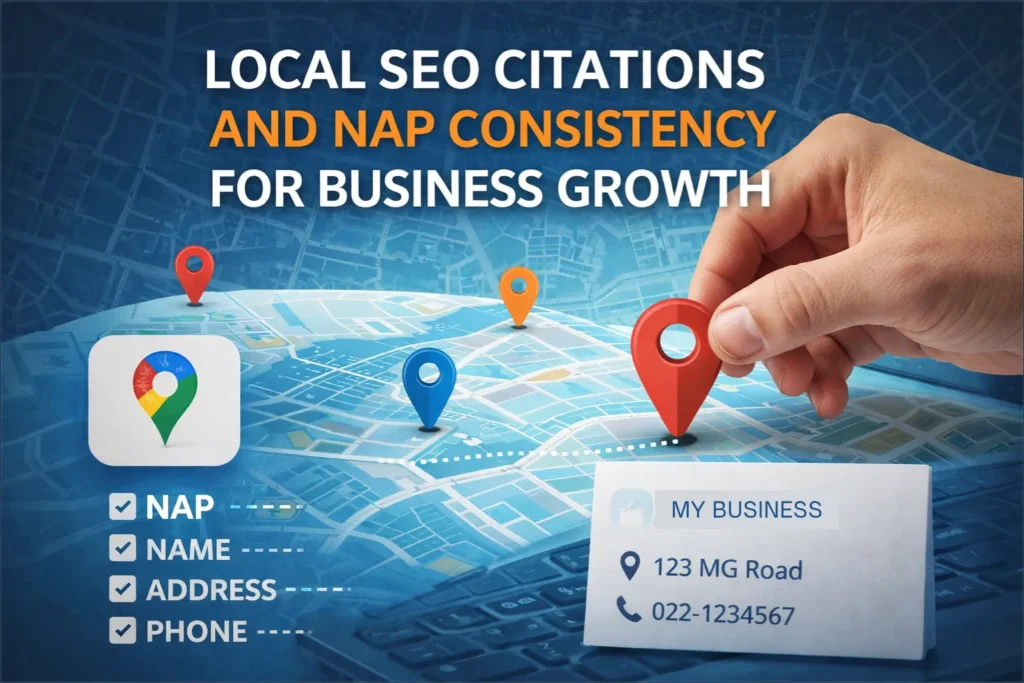
If you are a business owner in a competitive hub like Mumbai, you’ve likely noticed a frustrating trend: some businesses seem to “stick” to the top of Google Maps, while others—even those with better services—stay buried on page two. You have already optimized your Google Business Profile, so what is the missing link?
The answer is often found in the “digital breadcrumbs” your business leaves across the internet. In the SEO world, we call these Local Citations and NAP Consistency. In this exhaustive guide, we will explore why these signals are the backbone of local authority, how to perform a professional-grade audit and why this technical depth is the key to ranking higher.
When I started working on local SEO for small businesses, I noticed one common issue — most listings had inconsistent NAP details. Even a small mismatch like “Road” vs “Rd.” affected rankings.
If your business is not ranking on Google Maps despite good service, inconsistent citations might be the hidden reason.
In this guide, I’ll share practical strategies (not theory) to fix citation issues and improve local visibility.
What Exactly are Local SEO Citations?
First, let’s understand what a local citation is. Think of it as a digital footprint that displays your business’s essential contact details across various internet platforms. Unlike a standard backlink that you might focus on in Off-Page SEO, a citation does not always need a “clickable” link to be effective.
As we all know Google’s algorithm works as a powerful verification engine. It scans the entire web to see if the information you provide on your website matches what the rest of the world says about you. Every time your business is mentioned on a directory, a social media profile, or a local news site, it acts as a “vote” for your legitimacy.
The Frame of a Citation: NAPW
To be effective, a citation must include the NAPW data:
- Name: Your full, legal business name.
- Address: Your physical location, including shop/suite numbers.
- Phone: A local area code number.
- Website: Your primary domain (e.g.,
digitalsmartguide.com).
Real Example: NAP Consistency Impact on Rankings
A local home service business in Mumbai had different phone numbers listed across platforms like Google Business Profile, Justdial and their website.
After correcting and standardizing their Name, Address and Phone Number (NAP) across all listings, they experienced:
- Improved visibility in local search results
- Increase in customer calls
- Better trust signals from Google
Incorrect:
ABC Plumbing, 12 Street Rd
Correct:
ABC Plumbing Pvt Ltd, 12 Street Road, Mumbai, Maharashtra 400001
This demonstrates how even small inconsistencies can affect your local SEO performance.
The Logic of NAP Consistency

Building the “Trust Signal”
Why does Google care if you write “MG Road” on one site and “M.G. Rd” on another? It seems like a small detail, but to a computer algorithm, these are two different pieces of data.
To meet Google’s rigorous E-E-A-T standards, a business must demonstrate its reliability, making local SEO the definitive real-world proof that your brand is a credible choice for nearby customers. If your data is fragmented—meaning your address or phone number varies across different sites—Google loses “confidence” in your business.
When Google is unconfident, it won’t risk showing your business in the “Local 3-Pack” because it doesn’t want to provide a user with a wrong address or a dead phone line. It might sound like a small detail, but in real projects, this is where most businesses struggle without even realizing it.
Real Example: NAP Issue Impact
A local service business had listings on multiple directories, but the phone number was different on 3 platforms.
After fixing consistency across all listings:
- Rankings improved in 2 weeks
- Google Business Profile visibility increased
- Call inquiries increased by ~30%
How Local Citations Impact the Algorithm

The local search algorithm is built upon three core pillars—Prominence, Distance and Relevance—which collectively decide where a business appears in Map results.
- Relevance: Measures the alignment between a company’s profile information and the specific terms or intent entered by a potential customer.
- Distance: How far you are from the person searching.
- Prominence: How well-known your business is.
Citations directly feed the “Prominence” factor. The more high-quality, consistent citations you have, the more “prominent” you appear to the algorithm. This is a core part of Mastering Technical SEO—ensuring that the data surrounding your website is as optimized as the code within it.
| Factor | Why It Matters |
|---|---|
| NAP Consistency | Builds trust with Google |
| Citations | Improves local ranking signals |
| Reviews | Increases credibility |
| Local Listings | Enhances visibility |
Structured vs. Unstructured Citations
Remember, to build a professional SEO profile, you need a balance of two types of mentions:
1. Structured Citations
These are the most common. They appear in business directories where the data is organized in a set field (Name, then Address, then Phone).
- Examples: Yelp, Yellow Pages, Facebook Business and Bing Places.
2. Unstructured Citations
These are mentions of your business in a natural sentence on a website that isn’t a directory. These are actually more powerful because they are harder to get.
Example: A local Mumbai news site mentioning “Digital Smart Guide’s latest seminar on SEO.”
Where to Build High-Authority Citations
If you want to rank in Mumbai or any major city, start with these “Big Five” categories:
- Search Engines: Ensure your Google Business Profile matches your Bing Places for Business profile exactly.
- Social Networks: Your Facebook Page and LinkedIn Company Page should have your full NAP in the “About” section.
- Major Local Players: In the Indian market, prioritize Justdial, Indiamart, and Sulekha.
- Industry-Specific Sites: If you are a marketer, get listed on Clutch.co or Sortlist.
- Hyper-Local Sites: Look for “Mumbai Business Directories” or local community portals.
Pro Tip: You can earn these by being active in your community or through strategic guest posting as part of your Off-Page SEO efforts.
The Professional 4-Step Citation Audit
Before you spend time building new listings, you must “clean the slate.” Follow this workflow:
Step 1: The Google “Deep Search”
Search for your business using “exact match” operators. Try searching for:
"Your Business Name" + "Old Phone Number""Your Business Name" + "Partial Address"This will reveal old, hidden listings that are confusing Google.
Example: "ABC Plumbing Mumbai"
Step 2: The Comparison Spreadsheet
Document every listing you find. Note which ones are “Clean” (correct info) and which ones are “Dirty” (wrong info).
Step 3: The Correction Phase
Log in to your accounts and update them. For sites where you don’t have an account, use the “Suggest an Edit” or “Claim this Listing” feature. This process is tedious, but it is exactly the kind of “manual quality work” that Google appreciates—it shows you are a real expert.
Step 4: Duplicate Deletion
If a site like Justdial has two listings for you, it is hurting your SEO. Contact their support to merge the listings so that all your “ranking power” goes to one profile.
Quick Case Insight
In one case, a business had 2 duplicate listings on Justdial with slightly different phone numbers. After merging them into a single listing, their Google Maps ranking improved within a month and customer calls became consistent.
From my experience, most businesses skip the audit phase and jump directly into creating new listings. This is a mistake. Cleaning incorrect data first delivers faster and more stable ranking improvements.
Honestly, this process is a bit time-consuming, but it’s one of the highest ROI tasks in local SEO.
Connecting Citations to Technical SEO
Understand, citations don’t live in a vacuum. To maximize their power, your website must be technically sound. If Google follows a link from a citation to your site and finds a slow-loading page or broken links, the “Trust Signal” is broken.
Use Google Search Console to monitor your “Core Web Vitals.” Ensure your Robots.txt is optimized so that Google can crawl your site efficiently after it discovers you through a citation.
Furthermore, using Schema Markup (specifically “LocalBusiness” schema) on your website is like giving Google a “cheat sheet” to verify your NAP data instantly.
Quick Tips
- Always use the same format for your business name
- Keep a master document for NAP details
- Audit citations every 3–6 months
- Use Google Business Profile as primary reference
Common Local SEO Pitfalls to Avoid
- Keyword Stuffing: Never change your business name to e.g. “Digital Smart Guide – Best SEO Mumbai.” Use your real name. Keyword stuffing can lead to a Google Business Profile suspension.
- Virtual Offices: Avoid using virtual office addresses or P.O. Boxes. Google prefers “bricks-and-mortar” locations for local rankings.
- Inconsistent Formatting: If you use “Suite 10” on your website, don’t use “Room 10” on Yelp. Pick one format and stick to it.
- Ignoring Niche Sites: Many people stop after the big sites. Small, niche-specific directories often carry a lot of “Relevance” weight.
Tools for Citation Audit:
- Google Search
- Google Business Profile
- BrightLocal
Common NAP Consistency Mistakes
Let’s visually understand how NAP consistency directly impacts your local rankings:

- Using different business names across platforms
- Inconsistent phone numbers
- Old addresses not updated
- Duplicate listings
- Ignoring minor formatting differences
If you’ve never done a citation audit before, it may feel repetitive and time-consuming — and honestly, it is. But this is one of those SEO tasks where small details create big results over time.
Many business owners ignore citations because results are not instant, but this is one of those strategies that builds long-term stability.
Quick NAP Consistency Checklist
NAP consistency is a critical local ranking factor
- Use the exact same business name everywhere
- Keep one primary phone number
- Ensure address format is identical
- Update old or duplicate listings
- Monitor listings regularly
Local Search Intent Example
When users search for services like “electrician near me” or “medical shop in Mumbai,” Google checks multiple sources to verify business details.
If your NAP information is consistent across all platforms, Google confidently ranks your business higher.
But if there are mismatches, your rankings may drop due to lack of trust and confusion.
For More Information read this:
Why Fake Reviews Fail: Build Bulletproof Google Review Strategy
Service Area vs Physical Location: Local SEO Strategy to Rank in Every Neighborhood
Frequently Asked Questions (FAQs)
1. What is NAP in local SEO?
NAP stands for Name, Address and Phone Number used in business listings.
2. Does NAP consistency affect ranking?
Yes, inconsistent data can reduce trust and impact local rankings.
3. How often should I check citations?
At least every 3–6 months.
4. Does NAP consistency affect organic search results or just Maps?
While it primarily impacts the “Map Pack” and local rankings, it also provides a strong trust signal for your organic website rankings by confirming your business’s legitimacy.
5. How often should I audit my local citations?
It is best practice to conduct a full audit once a year, or whenever you change your phone number, address, or business name.
6. What is the most important citation site?
Without a doubt, your Google Business Profile is the most important. Everything else builds on the foundation you set there.
7. Can I use a mobile number for Local SEO?
You can, but a landline with a local area code (like 022 for Mumbai) is often seen as a stronger “local” signal by search engines.
8. How long does it take for citations to improve my ranking?
Citations are a long-term play. It typically takes 2 to 4 months for Google to crawl, index, and “trust” the new data across various directories.
9. Can I build citations for a service-area business without a physical office?
Yes. You can use your home address to verify your Google Business Profile (and hide it from the public), but your NAP consistency on other “unhidden” directories still helps build authority.
10. Do I need to pay for citation building services?
You can, but manual building is often better for quality control. It ensures that every listing is unique and correctly formatted.
11. What happens if I move my business address?
You must perform a “NAP Audit” immediately. Moving without updating your citations is one of the fastest ways to lose your local rankings.
Conclusion
NAP consistency is not just a technical SEO task — it directly impacts your business visibility and trust.
If you fix this properly, you’ll see real improvements in local rankings and customer engagement.
In my experience, businesses that fix their NAP consistency properly often see faster improvements than those focusing only on backlinks.
Remember to Link GSC and GA4 to see exactly how your local traffic is growing. As you build your local presence, keep your content helpful, your data clean and your strategy smart! 👍
Want to improve your local SEO faster? Start with fixing your Google Business Profile and reviews today.
Suggested Further Reading
- Rich Results Test Guide: How to Validate Schema and Fix All Errors
- SEO Basics: What You Must Know to Improve Your Rankings
- How Google Ranks Websites: The SEO Algorithm Explained
- SEO Mistakes to Avoid for New Websites (Beginner Guide)
- Noindex vs Robots.txt vs Canonical: When to Use What?
- Mastering Technical SEO: The Secret to High-Performance Websites
- Understanding Google Search Console: Grow Your Website Traffic
- Google Business Profile: Mastering Local SEO for Your Growth
- Off-Page SEO Guide: Strategies to Build Authority
- How to Optimize WordPress Robots.txt for SEO
✍️ About the Author
Digital Smart Guide is dedicated to simplifying SEO and digital marketing for beginners and professionals.
We share practical, easy-to-understand strategies based on real experience and ongoing learning from Google updates.
Disclaimer
This content is for informational purposes only. Results may vary based on your niche, competition, and implementation. Always apply strategies based on your specific needs.