When you start your journey in digital marketing, you often hear that “Content is King.” While that is true, having great content is only half the battle. If On-Page SEO is about making your house look beautiful from the inside, Off-Page SEO is about making sure the rest of the neighborhood knows you exist and trusts you.
When I first started working on SEO, I focused only on on-page optimization like keywords and content. But even after publishing well-optimized articles, rankings didn’t improve much.
That’s when I realized the real difference comes from off-page SEO — how your website is perceived across the internet, not just how it looks internally.
In this guide, we will break down everything you need to know about Off-Page SEO in simple terms so you can start ranking higher on search engines.
What is Off-Page SEO?
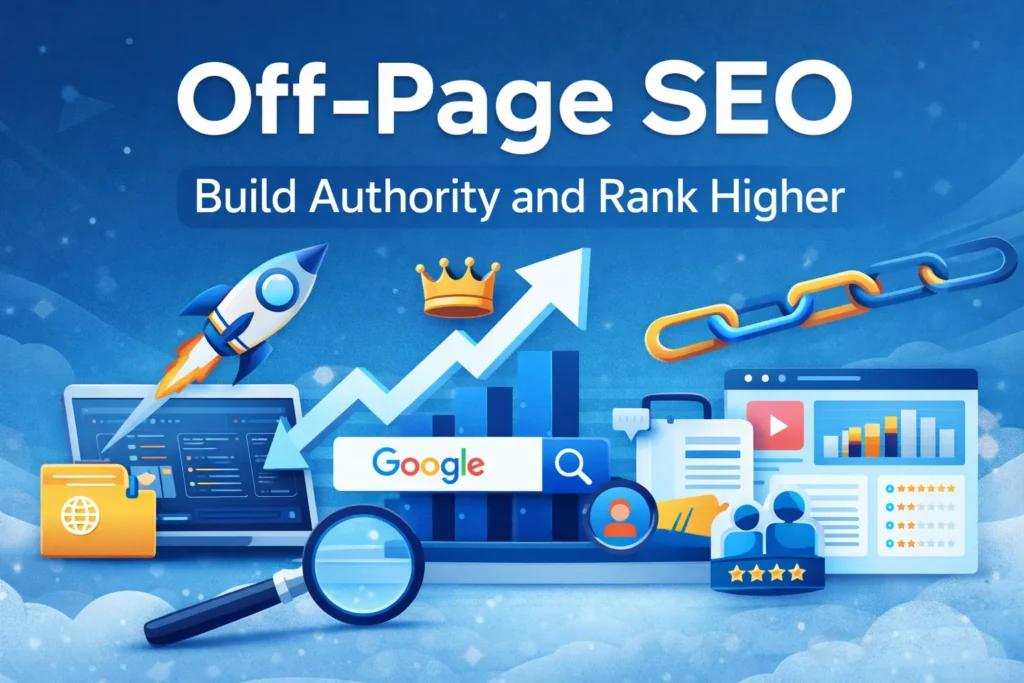
Off-Page SEO refers to all the activities performed outside your website to improve its authority, trust and rankings in search engine results.
It includes backlinks, brand mentions, citations and online reputation signals.
Why is Off-Page SEO So Important?
Google’s algorithm is constantly changing, but one thing remains the same: Trust. A website with no external links is like a person with no friends—it’s hard for Google to know if you are an expert or just another spam site. Off-Page SEO helps you:
- Increase Authority: It proves you are a leader in your niche.
- Improve Rankings: Higher authority usually leads to higher positions in search.
- Drive More Traffic: When you get mentioned on other sites, their audience finds you too.
Before you focus on Off-Page, ensure your foundation is solid. You should understand how search engines view your site by Understanding Google Search Console to track your progress.
Core Off-Page SEO Strategies & Advanced Authority Engineering

Off-page SEO extends beyond acquiring standard backlinks. Search algorithms analyze the mathematical quality, context, and link-equity distribution across your site’s entire external citation profile.
1. Technical Link Building & PageRank Math Mechanics
Not all links transfer equal value. Search engines evaluate external authority through a modified mathematical PageRank formula:
PageRank Transfer Concept:
PR(A) = (1 - d) + d * (PR(T1)/C(T1) + ... + PR(Tn)/C(Tn))
Where d is the damping factor (~0.85), and C(T) represents the total outgoing links from the linking page.
This means a single contextual link from a page with high equity and only 3 outgoing links transfers substantially more authority than a link from a page listing 100 external links.
2. Anchor Text Profile Optimization & Safety Thresholds
Google’s Penguin algorithm updates evaluate the natural distribution of your inbound anchor text. Over-optimizing exact-match keywords triggers manual or algorithmic spam flags.
| Anchor Type | Example Text | Target Distribution Ratio | Algorithmic Risk Level |
|---|---|---|---|
| Branded Anchors | “Digital Smart Guide”, “DSG Team” | 40% – 50% | Very Low (Establishes Entity Trust) |
| Naked URLs | “digitalsmartguide.com”, “https://…” | 20% – 25% | Low (Natural Web Citation Pattern) |
| Partial-Match / LSI | “read this off-page SEO checklist” | 15% – 20% | Moderate (Safe Contextual Signal) |
| Exact-Match Keywords | “Off-Page SEO Guide” | Under 5% – 10% | High (Spam/Penalty Risk if overused) |
3. Link Quality & Toxic Link Audit Workflow
Before launching outreach or guest posting campaigns, audit candidate sites against this 4-step quality framework:
- Traffic-to-Domain Rating Ratio: Ensure the linking site receives organic search traffic (at least 1,000+ monthly visits via GSC/Ahrefs). A high Domain Rating site with zero organic traffic usually indicates a private blog network (PBN).
- Outbound Link Neighborhood: Verify that the target domain does not link heavily to questionable industries or unvetted directories.
- Rel Attribute Validation: Differentiate between
rel="dofollow"(transfers equity),rel="nofollow"(hints discovery), andrel="sponsored"/rel="ugc"(paid or user-generated tags). - Disavow File Protocol: Maintain a clean link profile by submitting toxic spam links through the Google Search Console Disavow Tool only when algorithmic warnings or manual actions are detected.
4. Content Marketing & Linkable Assets
You can’t build high-quality links without creating valuable assets that creators want to reference. Strategic content formats include:
- Videos & Infographics: Highly shareable visual formats that earn contextual embeds.
- PDF & Resource Guides: Uploading exhaustive technical guides to authority repositories.
- Digital PR & Press Releases: Distributing noteworthy original research to industry publications.
5. Social Media Presence & Brand Signals
While direct social interactions do not transfer PageRank, viral reach increases content visibility, driving secondary editorial backlinks from bloggers and news outlets who discover your work.
6. Local SEO & Citation Consistency
For location-focused businesses, Local SEO relies on maintaining uniform Name, Address, Phone number, and Website URL (NAPW) signals across high-trust directories and your Google Business Profile.
| Off-Page Factor | Role in Algorithmic Evaluation |
|---|---|
| Backlinks | Transfers PageRank equity and establishes domain authority. |
| Brand Mentions | Unlinked citations confirm real-world entity existence to Google. |
| Social Signals | Expands organic reach and referral traffic channels. |
| Citations & Reviews | Strengthens local pack trust and user E-E-A-T signals. |
The Difference: On-Page vs. Off-Page vs. Technical SEO

- On-Page SEO: Optimizing things on your site (keywords, headings, images).
- Technical SEO: Improving the backend (like Mastering Technical SEO or optimizing your WordPress Robots.txt).
- Off-Page SEO: Building your site’s reputation through external signals.
Indexing Signals, Social Bookmarking, and Overcoming “Crawled – Currently Not Indexed”
Even with a robust backlink profile, pages can sometimes get stuck in Google Search Console as “Crawled – Currently Not Indexed.” To accelerate discovery and indexing, leverage social bookmarking platforms (such as Reddit, Quora, or Pinterest) and content-sharing networks to push fresh external traffic and signals to your URLs. When search engine crawlers detect active social engagement, brand mentions, and referring links pointing to a newly published or updated page, it signals high utility and prompts a faster re-crawl and inclusion in the main index.
Advanced Off-Page SEO Tips
The Role of Brand Mentions
Even if a website mentions your brand name without a direct link, Google still notices! These “unlinked brand mentions” help establish you as a real entity. This is why being active in forums and online communities is vital.
Competitor Analysis
One of the best ways to grow is to see where your competitors are getting their links. If a website links to them, they might link to you too if you provide even better content.
To analyze how these external factors affect your traffic, it is essential to Link GSC and GA4 so you can see exactly which external sources are sending you the most valuable visitors.
If you haven’t optimized your website yet, check our complete On-Page SEO guide before starting off-page strategies.
Building Trust with E-E-A-T
While building links is important, Google also looks at the reputation of the people behind the website. This is known as E-E-A-T. Off-Page SEO is the best way to prove to search engines that you are a real expert.
How to Improve E-E-A-T Off-Page:
- Online Reviews and Ratings: Positive reviews on platforms like Google Business Profile, Trustpilot or Yelp act as a massive trust signal. If people are praising your services online, search engines see you as a “Trusted” entity. This is why managing your Google Business Profile is so critical.
- Interviews and Podcasts: Being a guest on a podcast or being interviewed for an industry news site shows “Expertise.” Even if there isn’t a direct backlink, the mention of your name alongside a specific topic (like Digital Marketing) helps Google connect you to that niche.
- High-Quality Directory Listings: Getting listed in professional, industry-specific directories shows “Authoritativeness.” Avoid “spammy” directories; instead, look for directories that are well-known in your specific field.
- Public Speaking and Webinars: If you are invited to speak at a digital marketing event or host a webinar, ensure the event organizers mention your website on their landing pages.
Why Trust Matters Most
Google’s main goal is to provide users with accurate information. By focusing on E-E-A-T, you aren’t just “gaming” the system with links; you are building a real brand. When you Master Technical SEO, you fix the house. When you focus on E-E-A-T, you build a reputation that lasts for years.
Common Off-Page SEO Mistakes to Avoid
- Buying low-quality backlinks: Never pay for cheap links on sites like Fiverr. Google will penalize your site.
- Irrelevant Links: If you have a food blog, getting a link from a car repair site doesn’t help you much.
- Over-Optimizing Anchor Text: Using the same anchor text repeatedly. Don’t use the exact same keyword for every link. Keep it natural.
- Ignoring brand mentions
- Focusing only on quantity, not quality
- Building links too fast (unnatural growth)
Off-page SEO is not a quick task. It takes time, consistency and patience — but once authority starts building, the results compound over time.
Frequently Asked Questions (FAQs)
1. How long time does it take for Off-Page SEO to work?
It usually takes 3 to 6 months to see significant results, depending on competition and consistency.
2. Are backlinks the only part of Off-Page SEO?
No. While backlinks are the most important part, Off-Page SEO also includes social media marketing, influencer outreach and brand mentions.
3. What is a “Good” backlink?
A good backlink comes from a reputable, high-traffic website that is relevant to your specific niche or industry.
4. Can I do Off-Page SEO for free?
Yes! Guest posting, social media engagement and listing your business in directories are all free ways to improve your Off-Page authority.
5. Is off-page SEO only about backlinks?
No, it also includes brand mentions, social signals, and online reputation.
6. Which is more important: on-page or off-page SEO?
Both are important, but off-page SEO builds authority.
Conclusion
Off-Page SEO is a marathon, not a sprint. It’s about building a brand that people trust and want to talk about. By combining high-quality link building with a strong social media presence and solid content marketing, you will see your rankings climb over time.
Remember, SEO is a complete package. You need a fast, technical site, great On-Page content, and a strong Off-Page reputation to truly succeed in the digital world.
Suggested Further Reading
- Readability & Parsing Errors in SEO (Beginner Guide)
- Noindex vs Robots.txt vs Canonical: When to Use What?
- Canonical URL Explained: The Complete Guide to Fix Duplicate Content
- Sitemaps vs. Robots.txt: Which One Controls Your SEO? (Guide)
- Most Common Google Search Console Errors (404, Discovered and Crawled)
- Free Product Schema Generator Tool – (JSON-LD): Instantly Create Markup
- Free Event Schema Generator Tool – Add Event JSON-LD for Google Rich Results
- Best Digital Marketing Tools for Small Businesses – Choose Smartly
- The Ideal Guide to Domain, Hosting and WordPress for Beginners
- The Ultimate Guide to Image SEO: Rank Higher and Load Faster
✍️ About the Author
Digital Smart Guide is dedicated to simplifying SEO and digital marketing for beginners and professionals.
We share practical, easy-to-understand strategies based on real experience and ongoing learning from Google updates.
Disclaimer
This content is for informational purposes only. Results may vary based on your niche, competition, and implementation. Always apply strategies based on your specific needs.