
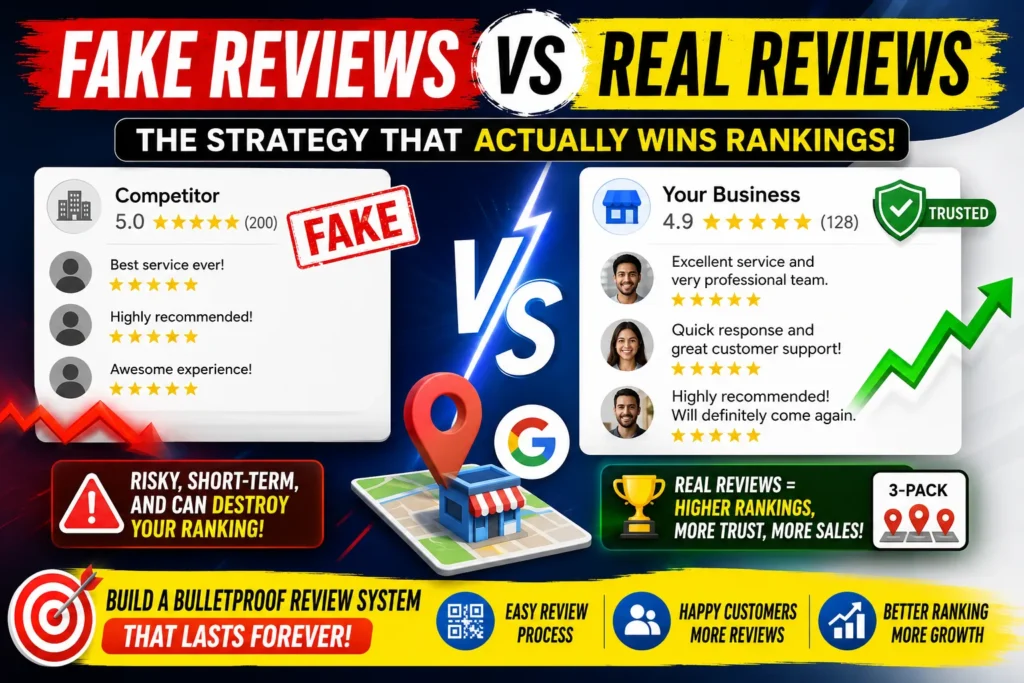
What are fake Google reviews?
Fake Google reviews are artificially created ratings posted using fake accounts or incentives to manipulate rankings.
If you are running a local business and trying to rank in Google’s highly competitive Maps 3-Pack, you’ve probably noticed something frustrating.
Your competitors seem to have:
- Hundreds of 5-star reviews
- Rapid rating growth
- Higher visibility than you
Meanwhile, your business:
- Gets genuine reviews
- Delivers real value
- But struggles to rank
This creates a serious question:
Are fake reviews beating honest businesses?
The short answer: Temporarily, yes. But not for long.
In this guide, you’ll understand:
- Why fake reviews don’t last
- How Google detects manipulation
- Why competitors suddenly drop rankings
- And most importantly — how to build a bulletproof review system that actually sticks
- Why Fake Reviews Are a Short-Term Gain but Long-Term Risk
- Why Fake Reviews Seem to Work (At First)
- Why Fake Reviews Eventually Fail
- The Real Winner: Organic Review Strategy
- How to Build a Bulletproof Review Process
- How Reviews Impact Google Maps Ranking
- The Psychology Behind Customer Reviews (Why People Actually Leave Them)
- Case Study: Real vs Fake Review Strategy (What Actually Wins)
- Real Example: Fake Reviews vs Real Trust in Local SEO
- Why Real Reviews Help You Rank in Specific Locations
- The Hidden Advantage of Real Reviews
- Frequently Asked Questions (FAQs)
- Conclusion
Why Fake Reviews Are a Short-Term Gain but Long-Term Risk
Many businesses believe that adding fake 5-star reviews will instantly boost their rankings.
And in some cases, they might see temporary improvement.
But here’s the reality:
Google’s systems are designed to detect unnatural review patterns over time.
When a business suddenly receives:
- Multiple 5-star reviews within a short period
- Reviews without detailed feedback
- Repetitive or generic language
It raises red flags.
Instead of helping, this can lead to:
- Reduced visibility
- Suspicious profile signals
- Loss of customer trust
In simple terms:
Fake reviews might give a short spike—but they damage long-term growth.

Why Fake Reviews Seem to Work (At First)
Let’s be honest — fake reviews can give short-term gains.
Businesses using shady tactics often:
- Buy bulk reviews from freelancers
- Use fake accounts or bots
- Ask friends to leave irrelevant reviews
- Post multiple reviews in a short time
This creates a sudden spike in:
- Review count
- Star rating
- Activity signals
Google’s algorithm initially sees:
- Increased engagement
- Higher user interaction
- Fresh content signals
And temporarily boosts rankings.
But here’s the catch:
Google’s system is not static — it continuously audits behavior.
The Hidden Risk Most Businesses Ignore
What many businesses fail to realize is that fake reviews don’t just risk removal — they damage your long-term ranking profile.
Google doesn’t evaluate your business only once. It continuously monitors patterns over time.
When your listing shows unnatural behavior, such as sudden review spikes followed by inactivity, it creates a trust imbalance.
This imbalance can lead to:
- Lower visibility in competitive searches
- Reduced appearance in the Google Maps 3-Pack
- Weak engagement signals from users
Even worse, once your profile is flagged as “low trust,” recovery becomes significantly harder than building credibility from scratch.
In simple terms:
Fake reviews don’t just stop working — they can hold your business back for months.
That’s why smart businesses focus on consistency, not shortcuts.
Why Fake Reviews Eventually Fail
Google has advanced systems designed to detect unnatural patterns.
Here’s what triggers red flags:
1. Sudden Review Bursts
If a business gets 50 reviews in 2 days and none afterward, it looks unnatural.
2. Repetitive Language
Fake reviews often repeat:
- “Great service”
- “Highly recommended”
- “Best in city”
Google detects duplicate phrasing patterns.
3. Low-Quality Profiles
Fake reviewers often have:
- No profile picture
- No activity history
- Only 1–2 reviews
4. Irrelevant Reviews
Reviews that don’t mention:
- Service details
- Location
- Experience
are considered weak signals.
5. Geographic Mismatch
Reviews from users in different cities or countries raise suspicion.
The Big Drop: Why Competitor Ratings Suddenly Crash
You might have seen this happen:
A competitor goes from:
⭐ 4.9 rating → ⭐ 3.8 rating
OR
Their reviews suddenly disappear.
This happens because:
Google’s Review Purge System
Google regularly removes:
- Spam reviews
- Fake accounts
- Policy-violating content
This leads to:
- Loss of ratings
- Drop in trust signals
- Ranking decline
Algorithm Updates
Google updates its local ranking algorithm frequently.
When it detects manipulation:
- Rankings drop
- Visibility decreases
- Sometimes listings get suspended

How Google Actually Understands Reviews
Google doesn’t just count stars — it reads meaning.
Its systems analyze:
- Review content (keywords + context)
- User behavior (clicks, calls, time spent)
- Reviewer authenticity
- Consistency over time
For example:
A review like:
“Good service”
Is far less valuable than:
“Best AC repair service in Andheri, quick response and fair pricing.”
Why?
Because detailed reviews provide:
- Context
- Location relevance
- Service clarity
This helps Google match your business with real search queries.
Google’s Official Policy on Reviews
Google clearly states:
Businesses must NOT:
- Buy reviews
- Offer incentives for positive reviews
- Post fake content
- Use employees to review their own business
Violating these rules can result in:
- Review removal
- Profile suspension
- Permanent ranking loss
The Real Winner: Organic Review Strategy
Instead of chasing shortcuts, successful businesses follow a consistent, ethical system.
Here’s why organic reviews win:
1. Trust Signals
Real reviews build credibility with users.
2. Long-Term Stability
Organic growth doesn’t trigger penalties.
3. Better Conversions
Customers trust authentic feedback more.
4. Stronger SEO Signals
Detailed reviews improve keyword relevance.
How to Build a Bulletproof Review Process
Now let’s get into the practical strategy you should implement.
1. Ask at the Right Time
Timing is everything.
The best moment to ask for a review is:
Immediately after a successful service
Examples:
- After a completed project
- After product delivery
- After positive feedback
When the experience is fresh, customers are more likely to respond.
2. Use QR Codes for Instant Reviews
This is one of the most effective offline-to-online tactics.
How it works:
- Generate your Google review link
- Convert it into a QR code
- Place it on:
- Bills
- Packaging
- Store counters
- Visiting cards
Customers simply scan and leave a review instantly.
This removes friction and increases response rate.
3. Keep the Process Simple
Avoid long instructions.
Instead, guide users like this:
- Click link
- Tap stars
- Write 1–2 lines
The easier it is, the more reviews you’ll get.
4. Train Your Team
Your staff plays a crucial role.
Train them to:
- Politely ask for reviews
- Identify happy customers
- Share review links confidently
Example:
“Sir/Madam, if you liked our service, a quick Google review would really help us grow.”
5. Maintain Consistency (Not Spikes)
This is the most important rule.
Don’t:
- Get 30 reviews in one week and stop
Do:
- Aim for 3–5 reviews per week consistently
Google prefers steady growth over sudden bursts.
6. Respond to Every Review
This is often ignored but highly powerful.
Why it matters:
- Shows engagement
- Builds trust
- Improves ranking signals
How to respond:
- Thank positive reviewers
- Address negative feedback professionally
Example:
“Thank you for your feedback! We’re glad you had a great experience.”
7. Encourage Detailed Reviews
Detailed reviews are more valuable than simple ratings.
Ask customers to mention:
- Service type
- Experience
- Specific highlights
Example:
Instead of:
“Good service”
Encourage:
“Quick installation and professional staff. Highly satisfied.”
8. Monitor and Report Fake Reviews
If competitors are using fake reviews, you can take action.
How to report:
- Go to Google Business Profile
- Find the review
- Click “Report review”
- Select reason (spam, conflict of interest, etc.)
You can also use Google Business Profile Help to escalate issues.
This helps level the playing field.
9. Avoid Common Mistakes
Never:
- Buy reviews
- Offer discounts for reviews
- Ask only for 5-star ratings
- Use fake accounts
These tactics might give short-term gain but long-term damage.
10. Track Your Progress
Monitor:
- Number of reviews
- Rating trends
- Customer feedback themes
This helps you improve both:
- Service quality
- SEO performance
How Reviews Impact Google Maps Ranking
Google considers three main factors:
1. Relevance
Do your reviews match search queries?
2. Distance
How close is your business to the user?
3. Prominence
This includes:
- Number of reviews
- Rating quality
- Engagement
Reviews directly impact prominence, making them a key ranking factor.
The Long-Term Advantage You Gain
By following an organic system, you build:
- Sustainable rankings
- Strong brand reputation
- Customer trust
- Higher conversions
While competitors using fake reviews:
- Face penalties
- Lose credibility
- Drop rankings
How Reviews Influence “Near Me” Searches
When users search for services like:
- “plumber near me”
- “best salon in [city]”
- “AC repair near me”
Google relies heavily on review signals to decide which businesses to show.
But it’s not just about ratings.
Google looks for:
- Location mentions inside reviews
- Service-specific keywords
- Fresh and consistent feedback
For example, a review that says:
“Quick AC repair in Thane, fixed within 2 hours”
is far more powerful than:
“Nice service”
Why?
Because it directly matches real search intent.
This helps your business appear in more local searches — even if your website isn’t highly optimized.
That’s the hidden SEO advantage of real reviews.
The Psychology Behind Customer Reviews (Why People Actually Leave Them)
Most businesses think getting reviews is just about asking.
But in reality, reviews are driven by human psychology — and understanding this can dramatically improve your results.
Let’s break it down.
People Leave Reviews for Emotional Reasons
Customers are more likely to leave a review when they feel:
- Extremely happy
- Extremely disappointed
- Personally connected to the experience
This means average service rarely gets reviews — memorable service does.
That’s why businesses with “okay service” struggle to collect reviews.
The “Reciprocity Principle” Works
When you go slightly beyond expectations, customers feel a natural urge to give back.
Examples:
- Quick support response
- Small free add-on
- Friendly communication
That “extra effort” creates a psychological trigger:
“They did something nice for me, I should return the favor.”
And that favor often becomes a review.
Social Proof Drives Action
People trust people — not businesses.
When customers see:
- Real names
- Detailed experiences
- Authentic photos
They feel more confident choosing your business.
That’s why 10 genuine reviews can outperform 100 fake ones.
Make Customers Feel Important
If you want more reviews, don’t just ask — appreciate.
Say things like:
- “Your feedback really helps small businesses like us grow.”
- “We truly value your opinion.”
This shifts the mindset from:
“You are asking for something”
to
“They are helping someone”
And that small shift increases response rate significantly.
Remove Hesitation
Many customers don’t leave reviews because:
- They think it takes too long
- They don’t know what to write
- They feel it’s not important
You can fix this by guiding them:
- “Just 1 line about your experience is enough.”
- “It takes less than 30 seconds.”
Simple reassurance = more reviews.
Key Takeaway
Getting reviews is not about pressure — it’s about creating the right experience and making it easy to respond.
Once you understand this, your review growth becomes natural and consistent.
Case Study: Real vs Fake Review Strategy (What Actually Wins)
Let’s compare two typical local businesses to understand how this plays out in real life.
Business A (Fake Review Strategy)
- Bought 100 reviews in 1 month
- Mostly 5-star ratings
- Short, repetitive comments
- No real customer engagement
Initial Result:
- Quick jump in ranking
- Appears in top 3 temporarily
After 2–3 Months:
- Reviews start disappearing
- Rating drops
- Ranking declines
- Trust issues increase
Business B (Organic or Real Reviews Strategy)
- Gets 3–5 real reviews per week
- Detailed customer feedback
- Responds to every review
- Encourages honest ratings
Initial Result:
- Slow growth
- Lower ranking at first
After 2–3 Months:
- Steady ranking improvement
- Higher engagement
- Strong trust signals
After 6 Months:
- Stable top 3 position
- Consistent leads
- Better conversion rate
What This Comparison Teaches Us
The difference is not speed — it’s sustainability.
Fake strategy:
- Fast growth
- Fast collapse
Organic strategy:
- Slow growth
- Long-term dominance
Final Insight
If your goal is:
- Quick visibility → fake reviews might tempt you
- Long-term success → organic strategy is the only way
And Google is getting smarter every day.
So the real question is not:
“How fast can I rank?”
It is:
“How long can I stay on top?”
If you’re serious about improving your local rankings, start implementing these strategies today — even small changes can make a big difference over time.
Real Example: Fake Reviews vs Real Trust in Local SEO
A salon in Mumbai tried to boost its rating quickly by adding fake 5-star reviews.
Initially:
- Rating increased
- Visibility slightly improved
But within weeks:
- Reviews got flagged
- Engagement dropped
- Customers stopped trusting the profile
Meanwhile, a nearby competitor:
- Had fewer reviews
- But all were genuine
- Included real photos and detailed feedback
Result: The competitor received more calls and bookings.
Case Study Insight: How Real Reviews Increase Conversions
A local electrician had:
- 4.2 rating
- Mixed, short reviews
After improving review strategy:
- Asked customers for detailed feedback
- Encouraged photo uploads
- Replied to every review
Within 45 days:
- Calls increased by 35%
- Website clicks improved
- Profile engagement doubled
The difference wasn’t more reviews — it was better reviews.
Local Intent Scenario: What Customers Actually Trust
When users search:
- “best electrician in Andheri”
- “trusted plumber near me”
They don’t just look at rating.
They check:
- Are reviews detailed?
- Do they mention real locations?
- Do they show real experiences?
Example:
❌ “Good service”
✅ “Fixed my wiring issue in Andheri within 2 hours. Very professional.”
Which one builds trust?
Clearly the second one.
Key Takeaway
| Factor | Fake Reviews | Real Reviews |
|---|---|---|
| Growth | Fast | Slow |
| Risk | High | None |
| Trust | Low | High |
| Ranking | Temporary | Stable |
Fake reviews may increase numbers…
But they destroy trust.
And in local SEO:
1. Trust = clicks
2. Clicks = customers
If you want real results:
- Focus on authentic feedback
- Encourage detailed experiences
- Build long-term credibility
That’s what actually drives rankings and conversions.
Why Real Reviews Help You Rank in Specific Locations
Reviews are not just for ratings — they act as local SEO signals.
When customers mention locations in reviews, like:
- “Great electrician in Borivali”
- “Fast AC repair in Thane”
Google connects your business with those areas.
This increases your chances of appearing in:
- Local searches
- Map results
- Area-specific queries
This is something fake reviews rarely achieve effectively.
The Hidden Advantage of Real Reviews
Real reviews don’t just help rankings — they improve conversions.
When users see:
- Detailed experiences
- Real customer stories
- Balanced feedback
They trust your business more.
This leads to:
- Higher click-through rates
- More calls and inquiries
- Better long-term growth
What Most SEO Guides Won’t Tell You
Many online guides talk about getting more reviews — but very few talk about review quality patterns.
From practical experience, businesses that rank consistently in the top 3 usually have:
- A steady flow of new reviews (not bursts)
- Detailed customer experiences
- A mix of ratings (not only perfect 5 stars)
- Active responses from the business owner
This creates a natural and trustworthy profile.
On the other hand, listings filled with only perfect ratings and generic feedback often trigger suspicion — both for users and Google.
In today’s local SEO landscape, authenticity is not optional.
It’s a ranking factor.
Frequently Asked Questions (FAQs)
1. Do fake reviews help Google ranking?
Yes, but only temporarily. Google eventually detects and removes them.
2. Can I report fake reviews on Google?
Yes, you can report them via Google Business Profile or support.
3. How many reviews do I need to rank?
There’s no fixed number. Consistency and quality matter more.
4. How often should I get reviews?
Aim for steady growth — weekly reviews are ideal.
5. Do review responses matter?
Yes, responding improves engagement and trust signals.
Conclusion
The truth is simple:
1. Fake reviews may offer short-term gains, but they rarely work in the long run.
2. Consistency and authenticity always win.
If your competitors are gaming the system, don’t panic.
Instead:
- Stay consistent
- Build genuine reviews
- Follow Google’s guidelines
Over time, you will:
- Outrank them
- Outlast them
- Outperform them
Fake reviews may look like a shortcut—but they are a risk.
Real reviews take time, but they build:
✔ Trust
✔ Authority
✔ Sustainable rankings
What Actually Works:
If you want long-term success on Google:
- Focus on real customer experiences
- Encourage detailed feedback
- Stay consistent
Because in modern SEO:
Authenticity is your biggest ranking advantage.
Suggested Further Reading
- Service Area vs Physical Location SEO: Why Most Businesses Choose Wrong (And Lose Rankings)
- SEO Basics: What You Must Know to Improve Your Rankings
- How Google Ranks Websites: The SEO Algorithm Explained
- SEO Mistakes to Avoid for New Websites (Beginner Guide)
- Noindex vs Robots.txt vs Canonical: When to Use What?
- Mastering Technical SEO: The Secret to High-Performance Websites
- Understanding Google Search Console: Grow Your Website Traffic
- Google Business Profile: Mastering Local SEO for Your Growth
- Off-Page SEO Guide: Strategies to Build Authority
- How to Optimize WordPress Robots.txt for SEO
✍️ About the Author
Digital Smart Guide is dedicated to simplifying SEO and digital marketing for beginners and professionals.
We share practical, easy-to-understand strategies based on real experience and ongoing learning from Google updates.
Disclaimer
This content is for informational purposes only. Results may vary based on your niche, competition, and implementation. Always apply strategies based on your specific needs.