
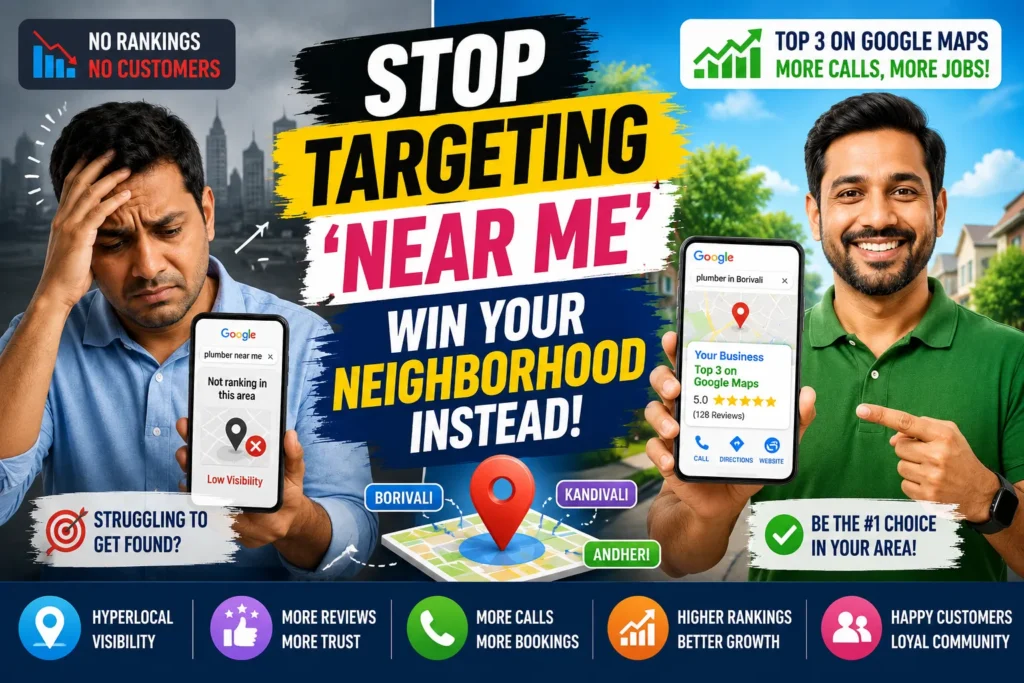
The “Service Area vs. Physical Location” Trap
If you run a service-based business—like a plumber, electrician, caterer or freelancer—you’ve probably faced this frustrating situation:
You serve a large area (like all of Mumbai), but when someone searches:
- “plumber in Borivali”
- “electrician in Andheri”
- “home cleaning in Thane”
Your business doesn’t show up.
Meanwhile, smaller competitors with physical shops in those areas dominate the results.
This creates a major challenge:
How do you rank in multiple neighborhoods without having a physical location in each one?
Many businesses try shortcuts like:
- Creating dozens of location pages
- Stuffing keywords like “Mumbai, Borivali, Andheri” everywhere
- Adding fake addresses
But these tactics don’t work anymore—and can actually hurt your rankings.
In this guide, you’ll learn a smarter, sustainable approach to rank across multiple neighborhoods without spam.
- Why Google Prioritizes Physical Locations
- Why “Near Me” Targeting Is Not Enough
- The Smarter Approach: Neighborhood-Level Targeting
- How Google Understands Service Area Businesses (And Why Most Get It Wrong)
- Real-World Examples (Service Area vs Physical Location)
- The “Proof Over Claims” Strategy That Dominates Local Rankings
- Case Study: Why Physical Locations Rank Faster
- The Hidden Power of Micro-Location Targeting
- Content Depth vs Content Volume (What Actually Wins)
- Local Search Intent Scenarios You Must Understand
- Real Example: Why a Kandivali-Based Business Outranks “All Mumbai” Listings
- Common Mistakes to Avoid
- Key Takeaway
- Expert Insight: What Most Businesses Get Wrong
- Frequently Asked Questions (FAQs)
- Conclusion
Why Google Prioritizes Physical Locations
To understand the problem, you need to understand how Google ranks local results.
Google uses three main factors:
1. Relevance
How well your business matches the search query.
2. Distance
How close your business is to the searcher.
3. Prominence
Your overall authority (reviews, engagement, etc.).
The Real Issue for Service Area Businesses
If your business is registered in one area (say Navi Mumbai), Google assumes:
You are most relevant near that location.
So when someone searches in Borivali, Google prefers businesses physically located there—even if you serve that area.
Why “Near Me” Targeting Is Not Enough
Many businesses target keywords like:
“plumber near me” or “electrician near me,” but this approach has limitations.
Here’s the problem:
- “Near me” results depend on the user’s location
- You can’t control where the user is searching from
- Competition is extremely high
This means relying only on “near me” limits your visibility.
The Smarter Approach: Neighborhood-Level Targeting
Instead of generic targeting, focus on:
High-intent, neighborhood-specific searches
Examples:
- “plumber in Borivali West”
- “AC repair in Kandivali East”
- “home cleaning in Vashi”
These searches:
- Have lower competition
- Show higher buying intent
- Convert better

Strategy 1: Optimize Your Google Business Profile Properly
Your Google Business Profile (GBP) is your strongest local SEO asset.
Choose the Right Primary Category
Your primary category should clearly define your core service.
Example:
- Plumber
- Electrician
- Cleaning service
Add Smart Secondary Categories
Instead of stuffing keywords, add relevant categories like:
- Drain cleaning service
- Emergency plumber
- Water tank cleaning
So, Google understands your services better.
Set Your Service Areas Correctly
Add all the areas you serve:
- Borivali
- Andheri
- Thane
- Navi Mumbai
But remember:
1. Adding service areas does NOT guarantee ranking there.
2. It only tells Google where you operate.
Strategy 2: Stop Creating Spammy Location Pages
This is where most businesses go wrong.
They create pages like:
- /plumber-borivali
- /plumber-andheri
- /plumber-thane
With almost identical content.
Why This Fails
Google sees this as:
- Duplicate content
- Low-value pages
- Keyword stuffing
Result:
1. Poor rankings
2. Possible penalties
Strategy 3: Create Real, Valuable Neighborhood Content
Instead of thin pages, create high-quality, localized content.
Example Content Ideas:
- “Common Plumbing Issues in Borivali Homes (And How to Fix Them)”
- “AC Maintenance Tips for Coastal Areas Like Mumbai”
- “How Hard Water in Thane Affects Your Plumbing System”
This content:
- Adds real value
- Targets local keywords naturally
- Builds authority
If you’re new to SEO content, start with keyword research
Strategy 4: Use Google Posts Like a Pro
Most businesses ignore Google Posts—but they are powerful.
What to Post:
- Completed projects
- Before/after work
- Customer experiences
- Area-specific updates
Example:
“Completed a full bathroom pipeline repair in Borivali West today.”
This signals to Google:
You actively work in that area.
Strategy 5: Collect Location-Specific Reviews
Reviews are one of the strongest ranking factors.
But here’s the trick:
Encourage customers to mention their location.
Example:
Instead of:
“Great service”
Encourage:
“Best plumber in Andheri, quick response and professional work.”
Why This Works
Google reads review text for:
- Keywords
- Locations
- Context
This helps you rank in those areas organically.
Strategy 6: Build Local Relevance Signals
You need to show Google that you are active in multiple areas. For this, use Local SEO Citations.
How to Do It:
- Get backlinks from local websites
- List your business in local directories
- Collaborate with nearby businesses
- Share local content on social media
Strategy 7: Use Internal Linking Smartly
If you create neighborhood content, link it properly.
Example:
- Blog → Service page
- Blog → Google Maps link
- Blog → Related area posts
This strengthens your SEO structure.
How Google Understands Service Area Businesses (And Why Most Get It Wrong)
One of the biggest misunderstandings in local SEO is how Google actually treats service-area businesses.
Most business owners assume that if they select multiple service areas in their Google Business Profile, they will automatically rank in all those locations.
But that’s not how it works.
Google does not rank your business simply because you say you serve an area. Instead, it looks for real-world signals that prove you are active and relevant in that location.
This is where most businesses fail.
They:
- Add 10–15 service areas
- Expect visibility everywhere
- But provide no supporting signals
From Google’s perspective, this looks like a claim without proof.
What Google Actually Looks For
To rank your business in a specific neighborhood, Google tries to answer:
Is this business genuinely active in this area?”
It uses multiple signals to decide:
- Customer reviews mentioning that location
- Content related to that area
- Engagement from users in that region
- Real interactions (clicks, calls, direction requests)
If these signals are missing, your chances of ranking remain low—even if you serve that area.
The Trust Gap Problem
There is a “trust gap” between:
- What your business claims
- What Google can verify
And your job is to close that gap.
You do this by:
- Publishing localized content
- Collecting area-specific reviews
- Posting real work updates
- Building local engagement
The Reality You Must Accept
You cannot force Google to rank you everywhere instantly.
Instead, you expand your presence gradually, area by area.
Think of it like this:
1. You are not “targeting locations”
2. You are building authority in locations
Once you understand this shift, your entire local SEO strategy becomes smarter, more sustainable, and far more effective.
Real-World Examples (Service Area vs Physical Location)
Understanding theory is good, but real examples make it crystal clear:
| Business Model | Has Physical Storefront? | Address Visibility | Primary Ranking Advantage | Best Suited For |
|---|---|---|---|---|
| Service Area Business (SAB) | No | Hidden on Google Maps | Flexibility to cover multiple areas | Plumbers, electricians, caterers, freelance home services |
| Physical Location Business | Yes | Visible on Google Maps | Strong distance/proximity signals in the local pack | Dental clinics, retail shops, restaurants |
| Hybrid Business Model | Yes | Visible on Google Maps | Both local foot traffic and broad service reach | Salons offering home service, hybrid repair shops |
Service Area Business Example
A plumber in Mumbai does not have a shop where customers visit. Instead, he travels to customer homes in areas like Andheri, Borivali, and Thane.
- No walk-in customers
- Address hidden in Google Business Profile
- Relies on service areas + reviews
This is a perfect Service Area Business (SAB).
Physical Location Example
A dental clinic in Mumbai has a proper clinic where patients visit.
- Fixed location
- Visible address on Google Maps
- Appears in “near me” searches strongly
This is a Physical Location Business.
Hybrid Example (Best of Both)
A salon that has a shop but also provides home services.
- Customers can visit
- Also travels to customers
- Uses both address + service area
This is a Hybrid Business Model.
The “Proof Over Claims” Strategy That Dominates Local Rankings

.If there’s one principle that separates top-ranking businesses from struggling ones, it’s this:
Proof always beats claims.
Many businesses say:
- “We serve all of Mumbai”
- “We provide service in every area”
But very few actually prove it.
And Google is built to reward proof.
What Are “Proof Signals”?
Proof signals are real, verifiable indicators that your business is active in a location.
These include:
- Photos from actual projects
- Customer reviews mentioning areas
- Google Posts showing completed work
- Detailed blog content about local issues
- Engagement from users in that region
These signals create a strong message:
“This business doesn’t just claim — it actually operates here.”
How to Build Proof Consistently
You don’t need to do everything at once. Start small and stay consistent.
For example:
After completing a job:
- Take a photo (with permission)
- Write a short Google Post
- Mention the area naturally
Example:
“Completed a full AC servicing project in Kandivali East today. The system had heavy dust buildup due to ongoing construction nearby.”
This single update does three things:
- Adds location relevance
- Shows real activity
- Builds trust with both Google and users
Why This Strategy Works Long-Term
Unlike shortcuts, proof-based SEO:
- Cannot be easily copied
- Builds genuine authority
- Improves trust and conversions
- Keeps your rankings stable
Even if competitors try to copy your keywords, they can’t copy your real-world activity.
The Compounding Effect
Over time, these small efforts create a powerful impact:
- More localized content
- More relevant reviews
- Stronger engagement signals
And gradually:
1. You start ranking in more neighborhoods
2. Your visibility expands naturally
Case Study: Why Physical Locations Rank Faster

Let’s understand with a simple scenario:
As shown above, Google’s local pack heavily favors businesses with strong proximity signals, which gives physical locations a ranking advantage.
A user searches:
“Plumber near me in Mumbai”
Business A (Service Area Only)
- No visible address
- Covers multiple areas
- Limited proximity signal
Business B (Physical Location)
- Verified address in Mumbai
- Strong map pin presence
- Higher trust signals
Result: Business B ranks higher in Google Maps
Why?
Google ranking depends on:
- Relevance
- Distance (proximity)
- Prominence
Physical businesses have a clear advantage in distance calculation, which directly impacts ranking
The Hidden Power of Micro-Location Targeting
Most businesses think in terms of cities.
But real opportunities exist at the micro-location level.
What is Micro-Location Targeting?
Instead of targeting:
“Plumber Mumbai”
Target:
- “Plumber in Borivali West near IC Colony”
- “Electrician near Vashi Sector 17”
Why This Works
- Very low competition
- Extremely high intent
- Better conversion rates
People searching like this are ready to hire immediately.
How to Implement It
- Mention landmarks in your content
- Use real project references
- Add local context naturally
Example:
“We recently completed a water leakage repair near Infinity Mall, Andheri.”
Content Depth vs Content Volume (What Actually Wins)
Many businesses think:
More pages = better ranking
But in reality:
Better content = better ranking
The Wrong Approach
- 20 thin location pages
- 200–300 words each
- Repetitive content
The Right Approach
- 5–10 high-quality articles
- 800–1500 words each
- Real insights and local relevance
Why Depth Matters
Google prefers:
- Detailed content
- Real experience
- Useful information
Deep content:
- Keeps users engaged
- Builds trust
- Improves ranking
.
Local Search Intent Scenarios You Must Understand
Different searches trigger different results:
“Near Me” Searches
Example: “Salon near me”
Google prefers:
- Physical locations
- Businesses close to the user
“Service-Based Searches”
Example: “AC repair in Mumbai”
Google shows:
- Service area businesses
- Businesses targeting that city
“Brand Searches”
Example: “ABC Plumbing Mumbai”
Google shows:
- Both SAB and physical listings
Key Insight:
- Physical location = better for local pack ranking
- Service area = better for coverage-based visibility
Real Example: Why a Kandivali-Based Business Outranks “All Mumbai” Listings
Let’s take a real-world scenario.
A plumber creates a Google Business Profile and selects:
“We serve all Mumbai”
Another plumber sets:
“Kandivali West” as primary location and posts regularly about local jobs.
Now, when someone searches:
“plumber near me in Kandivali”
Google prefers the second business because:
- It has a clear physical relevance
- It shows local activity
- It builds trust through location signals
Even if the first business technically serves that area, it appears less relevant.
Result: The hyperlocal business gets more calls.
Case Study Insight: Service Area Business vs Local Presence
A home cleaning service operating across Mumbai noticed:
- High impressions
- Very low calls
After optimizing:
- Added location-based posts (Borivali, Malad, Kandivali)
- Uploaded real job photos with area names
- Updated description with service areas
Within 30 days:
- Calls increased by 40%
- Direction requests improved
- Customer trust improved significantly
The shift was simple: from “generic coverage” to “local relevance.”
Local Intent Scenario: How Customers Actually Search
Users don’t search like businesses think.
They search like this:
- “AC repair in Andheri”
- “Electrician near Borivali West”
- “Plumber in Kandivali urgent”
Now imagine your profile says:
“Serving all Mumbai”
vs
“Same-day AC repair in Andheri West”
Which one feels more relevant?
Clearly the second one.
That’s exactly how Google thinks too.
Common Mistakes to Avoid
Avoid these at all costs:
- Creating fake addresses
- Keyword stuffing location names
- Copy-paste content pages
- Ignoring reviews
- Not updating Google profile
How Long Does It Take to See Results?
Local SEO is not instant.
Typical timeline:
- 1–2 months → Initial signals
- 3–4 months → Ranking improvement
- 6+ months → Strong local presence
Consistency is key.
Key Takeaway
Service area businesses don’t lose because of coverage.
They lose because of lack of local signals.
If you want better results:
- Be specific
- Show real work in real areas
- Align your content with local search intent
That’s how you compete with physical-location businesses.
Pro Tip:
If possible, having a real physical location gives stronger ranking advantage in competitive local SEO.
Expert Insight: What Most Businesses Get Wrong
Most service-area businesses fail because they think:
“Adding more locations = more visibility”
But Google doesn’t reward coverage.
It rewards proof + relevance + activity
If your competitors are ranking above you, it’s not because they serve more areas.
It’s because they demonstrate stronger local presence in specific areas.
| SEO Strategy Element | The Wrong Approach (Shortcuts) | The Right Approach (Proof-Based) |
|---|---|---|
| Location Expansion | Adding 10–15 fake or unverified service areas | Expanding gradually, area by area, with active signals |
| Page Creation | 20+ thin, duplicate location pages with 300 words | 5–10 deep, high-quality articles (800–1,500 words) |
| Reviews | Collecting generic “Great service” reviews | Encouraging customers to mention specific neighborhoods |
| Google Business Profile | Keyword stuffing location names into the profile | Setting proper primary/secondary categories and regular posts |
| Core Philosophy | Claiming broad coverage (“We serve all of Mumbai”) | Demonstrating real-world proof (photos, local case studies) |
Frequently Asked Questions (FAQs)
1. Can I rank in multiple areas without an office there?
Yes, by building strong local relevance through content, reviews, and activity.
2. Are location pages bad for SEO?
Only if they are thin or duplicate. High-quality pages are fine.
3. How do I rank in specific neighborhoods?
Use localized content, reviews, and Google Posts mentioning those areas.
4. Do service areas in GBP help ranking?
They help Google understand your reach but don’t guarantee rankings.
5. What is the best strategy for service area SEO?
Consistent content, optimized GBP, and real customer engagement.
Conclusion
The biggest mistake service-area businesses make is trying to trick Google instead of helping users.
If you want long-term success:
- Focus on real content
- Build local relevance
- Stay consistent
- Avoid shortcuts
You don’t need a physical location in every area.
You need:
Trust + relevance + consistency
And that’s what Google rewards.
Want to improve your local SEO step-by-step?
Start with these guides:
Explore more on Digital Smart Guide and start ranking smarter.
Suggested Further Reading
- Why Fake Reviews Fail: Build Bulletproof Google Review Strategy
- Local SEO Citations: The Ultimate Guide to NAP Consistency
- Off-Page SEO Guide: Strategies to Build Authority
- Mastering Off-Page SEO: The Authority Guide
- Technical SEO Secrets: Build a High-Performance Website
- Ultimate Guide to Keyword Research for Beginners
- Optimize WordPress Robots.txt for SEO (Complete Guide)
- Complete Guide to Google Business Profile and Local SEO Growth
- How to Link GSC and GA4 for Advanced Data Insights
- Understanding Google Search Console: Grow Your Website Traffic
✍️ About the Author
Digital Smart Guide is dedicated to simplifying SEO and digital marketing for beginners and professionals.
We share practical, easy-to-understand strategies based on real experience and ongoing learning from Google updates.
Disclaimer
This content is for informational purposes only. Results may vary based on your niche, competition, and implementation. Always apply strategies based on your specific needs.